


Bring cancer prevention and early detection to your membership
We assess each patient’s cancer risk, build a plan around it, coordinate testing, and adjust the plan as their risk changes. You stay informed and in charge of their care.
Give your patients another reason to stay
Adds value to your membership.
Oncologist-led prevention, added to the care you already provide.

Keeps patients engaged year-round.
Virtual care visits every six months, with results routed back through your practice.

Sets your practice apart.
Whole genome risk assessment and an oncology team, without hiring one.
A test is a snapshot.
Prevention is a program.
Each patient’s plan is overseen by medical oncologists and aimed at Stage Alpha: the window before cancer forms, when inherited risk and early warning signs can still be acted on.
How the virtual clinic works
You stay their physician. We assess their risk, build their plan, coordinate their testing, and adjust their plan as their risk changes, sharing every finding with you.
1
Embed or refer
Include the virtual clinic in your own program, or refer patients directly.
2
We assess and plan
Whole genome sequencing, family history, and health records, built into a personalized plan signed by a medical oncologist and updated as evidence evolves.
3
We monitor and act
Risk-informed imaging and risk-based bloodwork, ordered, scheduled, and read against your patient’s own baseline. Concerning findings go to a panel of medical oncologists, who direct follow-up until it’s resolved.
4
We keep you informed
You receive every result and recommendation, plus a summary every six months. You stay in charge of their routine care.
See what your patient gets
Every patient gets a Stage Alpha Assessment with whole genome sequencing, a personalized plan signed by a medical oncologist, first year testing, and a year-end visit.
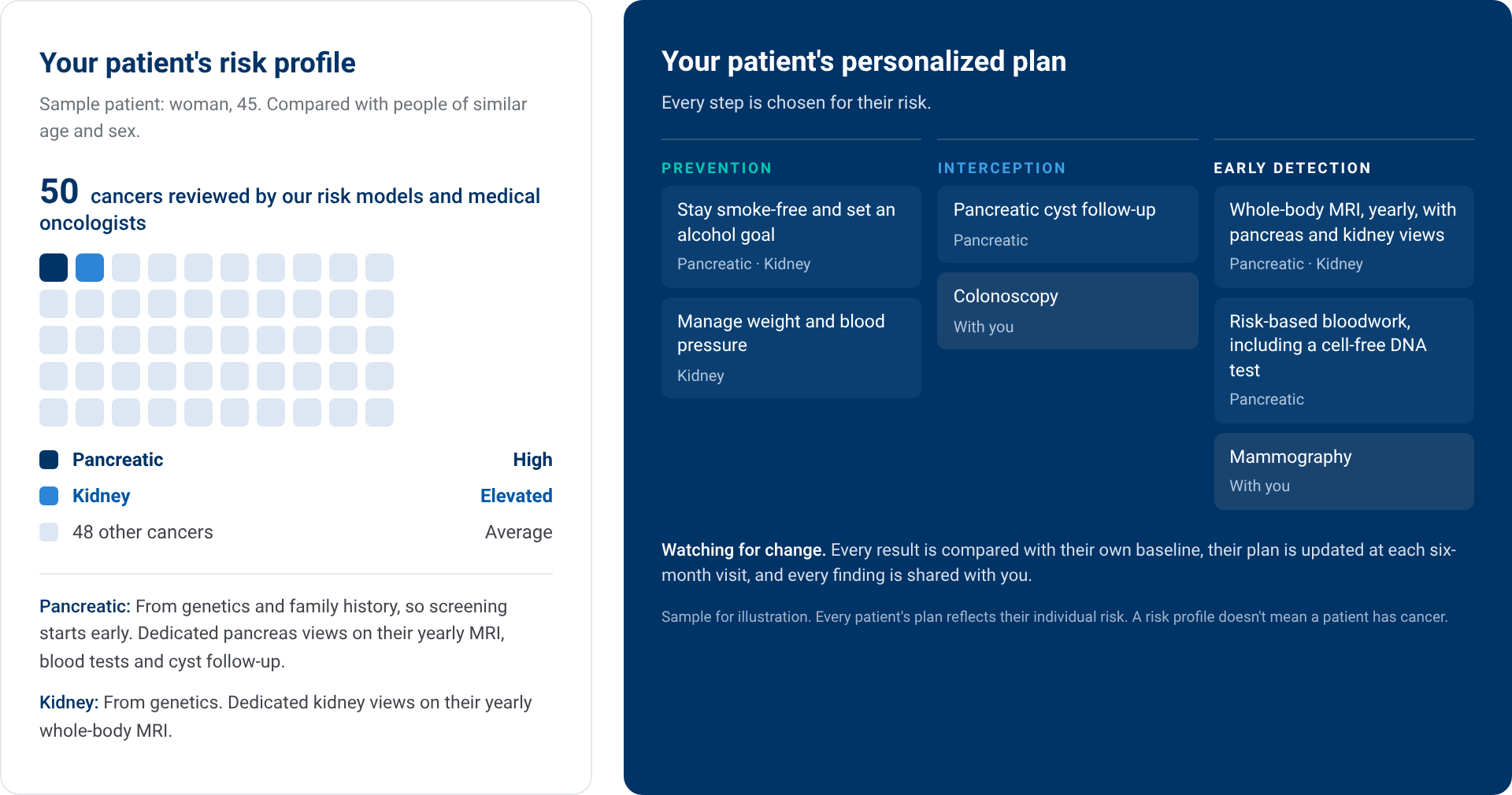
Turn your phone sideways for a better view.
Two ways to work with us
Embed the virtual clinic
Offer the virtual clinic as part of your membership, at the price you set, with minimal lift for your staff.
Best for
Concierge and longevity practices that want to differentiate their membership.
How it works
- Sign a partnership agreement
- Kickoff meeting with our clinical team
- Portal configuration
Refer patients
Your patient enrolls in the virtual clinic directly. You stay their physician and receive all results.
Best for
Practices that want oncology support without changing how they work.
How it works
- Fax a referral order. No records needed
- We contact your patient within two business days
- No agreement or billing required
Provider frequently asked questions
How do I refer a patient?
Fax a referral order to 561-268-0124, Attn: New Patient Referrals. No supporting records, agreement, or billing setup is needed. Refer as you would to any specialty practice. We contact your patient within two business days for an introductory consultation. Questions? Call 561-342-5115 or email [email protected]. Referrals are available for patients in Florida, Georgia, Ohio, and Texas.
Who handles results and follow-up?
We do. Our oncologists review any concerning result, decide next steps, and coordinate follow-up. You receive every result and recommendation, plus a summary every six months.
Does this replace my role?
No. You stay in charge of your patient’s routine care, including standard screenings like mammograms and colonoscopies. We add cancer prevention and early detection expertise.
What does it cost my patients?
It depends on how your practice offers the clinic.
If you embed the clinic: It’s included in your practice’s membership at the price you set.
If you refer: Year 1 is a 12-month membership that covers the cancer risk assessment, a personalized plan, and baseline testing. Patients pay $500/month or $5,700 annually (a $300 savings). Membership is HSA/FSA eligible.
Year 2 and beyond: Ongoing care continues at $2,500 per year for professional services, plus testing tailored to each patient’s risk and first-year findings. Many patients’ totals stay similar, and they can drop significantly when fewer tests or longer testing intervals are appropriate.
Which patients are a good fit?
Adults who want to understand and act on their cancer risk, especially those with a family history of cancer or who want more than age-based screening.