


Cancer prevention and early detection take more than a test. They take a program.
An oncologist-led care team that assesses your cancer risk, builds your personal plan, coordinates your testing, and adjusts the plan as your risk changes.
Most medicine waits for cancer to appear.
We work at Stage Alpha.
Stage Alpha is the earliest point where cancer can be prevented or acted on. That’s where your care in the virtual clinic begins.

We read all of your DNA, not a sample of it.
Whole genome sequencing, interpreted by medical oncologists.

Your results don't expire after your first assessment.
We reinterpret your genome as the science advances.

Oncologist-led, start to finish.
Medical oncologists created the clinic and oversee every plan.
How your virtual clinic membership works
1
Understand your cancer risk
It starts with your Stage Alpha Assessment. Our medical oncologists review your whole genome alongside your family history and health record to build your personal cancer risk profile.
2
Get your individual plan
A prevention, interception, and early detection plan built around your risk: what to watch, when to test, and practical steps to lower your risk.
3
Get tested, without the logistics
The imaging, bloodwork, and testing that fit your personal risk, from advanced imaging like risk-informed whole-body MRI to risk-based blood tests. We order and schedule all of it.
4
Stay on track
Video visits with our prevention care team every six months. Our oncologists update your plan as your results and the science change.
5
Get help with every result
If something looks concerning, our oncologists decide the next step and coordinate follow-up until it’s resolved. You’re never left to interpret it alone.
6
Keep your doctor in the loop
Your doctor gets every result and recommendation. You keep your routine care with them; we add the cancer prevention expertise.

Visits by video

Imaging
(scheduled for you)

Bloodwork
(at home by mobile phlebotomy)
Your care plan
See what a care plan looks like, with personal details removed.
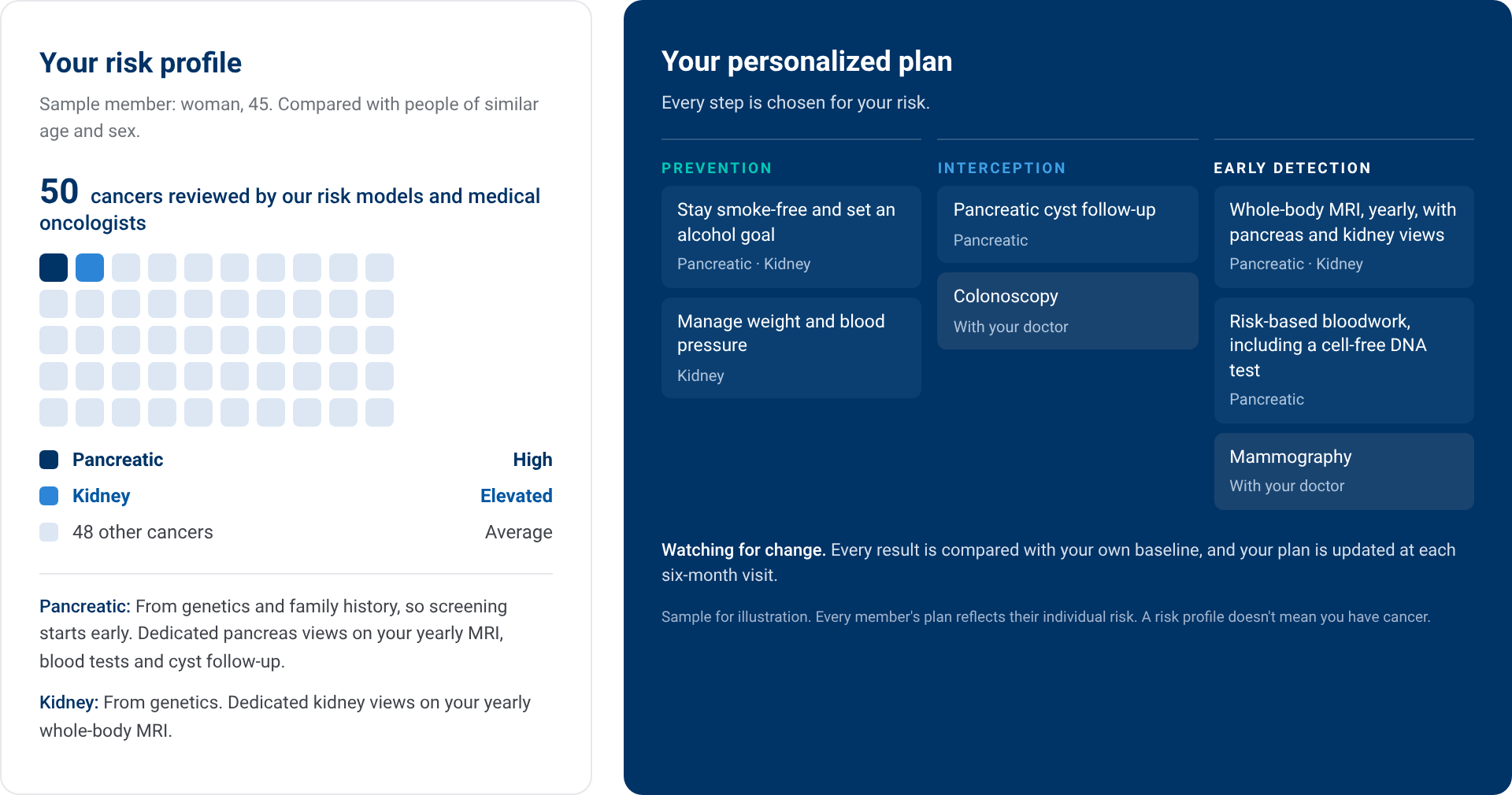
Turn phone sideways for a better view.
The best time to know an oncologist is before you have cancer
Cancer is the leading cause of death for U.S. adults ages 45 to 64. Most people meet an oncologist after a diagnosis. Our members have one on their side while they’re healthy.
Meet the leaders guiding your care
These leaders guide key areas of PreOncology, with a broader team supporting your care.
What’s included
Virtual Prevention & Early Detection Clinic
Your baseline year
$500 / month
or $5,700 / year when paid annually (save $300)
12-month membership | HSA/FSA eligible
Available in Florida, Georgia, Ohio, and Texas.
- Stage Alpha Assessment to evaluate individual risk across 50 cancer types
- A personalized plan, reviewed and signed by a medical oncologist
- Baseline whole-body MRI, baseline blood markers, and monitoring over 12 months
- Annual professional services, including cancer risk reassessment, two nurse practitioner visits, a visit with a genetic counselor, and medical oncologist supervision and intervention when clinically appropriate
- Review of guideline-based cancer screening ordered by your primary care physician
- Year-end 20-minute visit with a medical oncologist to review the previous year and the following year’s plan
Year 2 and beyond
Your professional services continue at $2,500 per year. Testing is tailored to your risk and first-year findings, so your total may stay similar or decrease significantly when fewer tests or longer testing intervals are appropriate. A specific reduction is not guaranteed.
Common questions
What does the membership include?
Your first year includes:
- A Stage Alpha Assessment with whole genome sequencing, interpreted by medical oncologists
- A personalized prevention and early detection plan, reviewed and signed by a medical oncologist
- A baseline whole-body MRI and blood markers
- Follow-up bloodwork based on your risk, drawn at home by mobile phlebotomy
- Video visits with your nurse practitioner every six months
- Oncologist review of any concerning result, with follow-up coordinated until it’s resolved
- Review of the screenings your primary care doctor orders
- A year-end visit with a medical oncologist to plan your next year
- Ongoing access to your prevention care team
- Your DNA re-read as the science advances
Routine screenings like mammograms and colonoscopies still go through your own doctor and insurance. We review those results as part of your plan, and your doctor gets every result and recommendation from us.
Is it a 12-month commitment? Can I pay monthly?
Yes, membership runs for 12 months. You can pay $500 a month, or $5,700 up front for the year and save $300. Membership is HSA/FSA eligible. From year 2 on, membership is $2,500 a year, plus any risk-based testing in your plan.
Does every member get the same tests?
No. Every member gets a full risk assessment and ongoing care, but your testing is chosen for your risk. The type of imaging, the bloodwork, and how often you’re tested all depend on your genetics, family history, and health history, and your plan is updated as your risk changes.
What happens if something concerning comes up?
If a result needs a closer look, it goes to our Signal Board, a panel of board-certified medical oncologists who review it together. They decide the right next step, and your care team coordinates any follow-up until it’s resolved. Your primary care doctor is kept informed, and you’re never left to interpret a result on your own.
I already see my doctor. Why do I need this?
We work alongside your doctor, not in place of them. Routine screening is based on age. We add a full assessment of your cancer risk, including your genome, and a plan built around it, overseen by medical oncologists. Your doctor gets every result and stays in charge of your routine care.
My genetic testing was negative. Am I still at risk?
Yes, though a negative result is still good news. Most cancer risk isn’t driven by a single inherited gene change. Standard hereditary testing looks at a set of known genes. We sequence your whole genome and interpret it alongside your family history and health record to estimate your risk for each cancer. As the science advances, our care team re-reads your results.