

Population-based screening guidelines and standard genetic tests were built for averages, not for a patient’s individual biology.
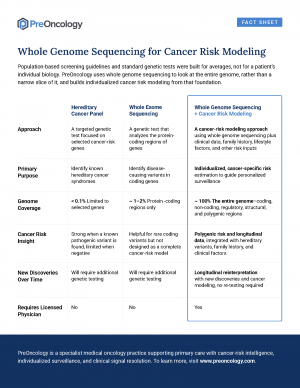
Most genetic tests look at a fraction of the genome. A hereditary cancer panel covers less than 0.1 percent, focused on a short list of known genes. Whole exome sequencing expands that to the protein-coding regions, roughly 1 to 2 percent of the genome.
PreOncology takes a different approach, using whole genome sequencing to examine the entire genome, coding and non-coding, and building individualized cancer risk models from that full picture.
Download the fact sheet to discover:
- The differences between a hereditary cancer panel, whole exome sequencing, and whole genome sequencing
- Why PreOncology uses whole genome sequencing to look at the entire genome to build individualized cancer risk modeling